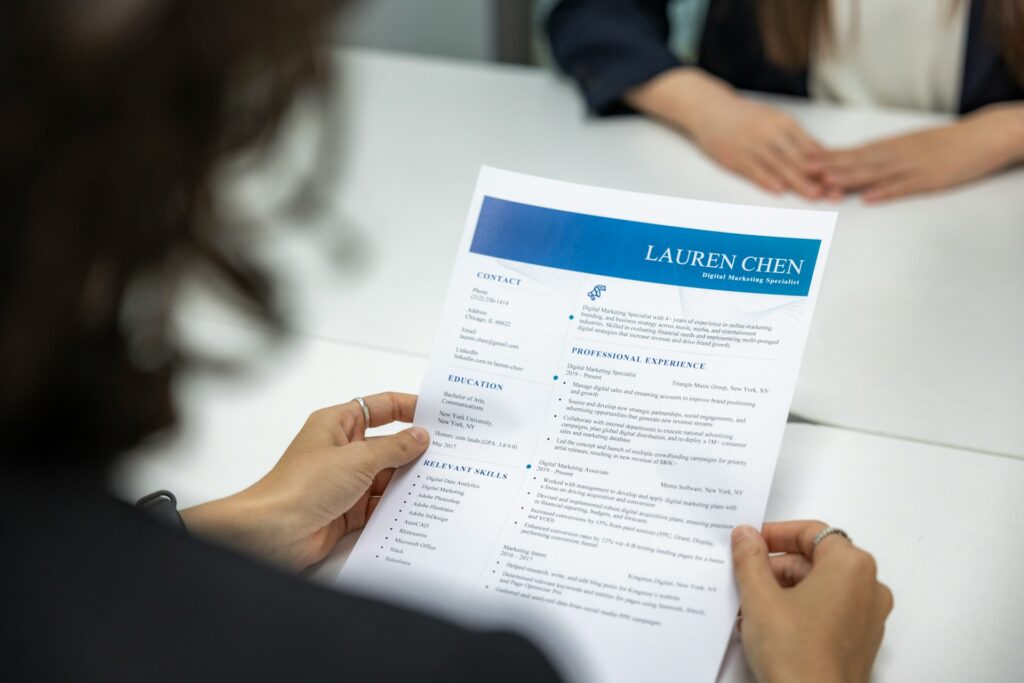
You may have the right experience for a job and still struggle to explain it on a resume. Important achievements can disappear behind vague descriptions, crowded formatting, or a summary that could belong to almost anyone.
A strong resume makes your relevant qualifications easy to find. It helps an employer understand what you have done, how your experience connects with the role, and what evidence supports your claims.
Learning how to write a resume starts with choosing the information that matters for a particular application. This guide explains how to make those choices and turn your experience into clear, useful statements. The sample wording is hypothetical; adapt it using details you can honestly support.
Start With the Job You Want
Read the job description before editing your resume. Pay attention to the work the person will perform, the skills required, and any instructions for applying.
An employer looking for a content publishing specialist may emphasize WordPress, formatting, quality checks, and deadlines. For that application, your experience preparing articles for publication deserves more attention than an unrelated responsibility from an older job.
The Harvard Mignone Center for Career Success recommends tailoring your resume to the position you are seeking and highlighting skills the employer would value.
Keep a master document containing your work history, projects, qualifications, and achievements. Use it to create a focused version for each application. This gives you a reliable record to work from as you choose the most relevant details.
Tailoring should preserve the facts. Keep job titles, employment dates, qualifications, and accomplishments accurate as you adjust the emphasis.
Organize Your Resume Around Relevant Evidence
Choose a structure that makes your strongest qualifications easy to understand.
For someone with relevant professional experience, work history will often deserve a prominent position. A recent graduate may give more space to education, internships, and projects. A career changer may benefit from a short summary connecting previous experience with the target role.
Whatever order you choose, make the work history clear. Include the employer, your job title, and consistent employment dates for each position. Present the most recent role first within that section.
CareerOneStop’s resume formatting guide, sponsored by the U.S. Department of Labor, recommends clear section headings, consistent formatting, and a simple layout.
Use familiar headings such as “Work Experience,” “Education,” and “Skills.” Give the reader enough space to distinguish sections and follow the document comfortably.
Make Your Opening Specific
The top of your resume should identify you and make it easy to contact you. Include your name, a professional email address, a phone number, and relevant links, such as a portfolio or LinkedIn profile.
If you include a professional summary, use it to explain your fit for the role. A useful summary gives the reader concrete information about your background and strengths.
For example, a hypothetical summary might read: “Content publishing specialist with three years of experience preparing WordPress articles, reviewing page formatting, and coordinating publication schedules. Experienced in Elementor, image optimization, and checking content against editorial guidelines.”
That wording identifies a type of work and relevant capabilities. Phrases such as “hardworking professional seeking a challenging opportunity” offer much less information.
A summary is optional. Include one when it adds context, especially if your career direction needs explaining. Keep it brief enough that it leaves room for evidence elsewhere in the resume.
Explain What You Did and Why It Mattered
Your experience section should help an employer understand your contribution.
“Responsible for website updates” describes a broad duty. A more informative statement would explain what you updated, how you completed the work, and any result you can verify.
For example, a hypothetical applicant might write, “Prepared and published 20 WordPress articles each week, checking headings, image placement, internal links, and mobile formatting before release.”
That statement shows the scope of the work and the quality checks involved. If the applicant also had reliable evidence of an improvement, they could describe it separately.
A useful way to develop an experience statement is to connect an action with its scope and result. Think about what you completed, who or what it affected, and what changed because of your contribution.
Use direct verbs that match the work. “Edited,” “built,” “coordinated,” “reviewed,” and “resolved” can help explain your role. Choose wording that accurately reflects your level of responsibility.
Use Numbers You Can Support
Numbers can make the scale of your work easier to understand. They might describe the number of clients you supported, projects you completed, articles you published, or people you trained.
They can also explain a result, such as a shorter turnaround time or fewer corrections. Use those measures when you have a reasonable basis for them.
For example, “Created a publishing checklist that reduced weekly formatting corrections from ten to three over two months” would be useful only if records supported the comparison and your contribution.
When several people helped achieve a result, explain your part. “Supported the launch by preparing product pages and checking links” describes a contribution without taking credit for the entire project.
You can also show value without a percentage or revenue figure. Documenting a process, resolving a recurring issue, or helping a team complete a deadline can be meaningful when you describe the work clearly.
Match Relevant Skills With Examples
A skills section helps readers locate qualifications, but your experience should show how you used them.
If a job requires WordPress, name WordPress where it accurately describes your work. If it asks for project coordination, explain an assignment in which you organized deadlines, communicated with contributors, or tracked progress.
Use the employer’s terminology when it matches your experience. This can make the connection between your background and the advertised role easier to recognize.
Keep your skill descriptions honest. Describe introductory knowledge, practical experience, and advanced capability accurately. You should be ready to discuss or demonstrate anything you include.
For broader strengths such as communication or organization, provide evidence through your work. Coordinating a publication schedule gives the reader more context than an unsupported claim of “excellent organizational skills.”
Keep the Layout Easy to Read and Process
Use a consistent font, clear headings, and short experience statements. A simple, single-column document is a practical starting point for many online applications.
Some employers use an applicant tracking system, or ATS, to manage applications. One feature these systems may provide is resume parsing, which extracts information from a file into application fields.
Greenhouse’s documentation on resume parsing identifies columns, graphics, complex tables, and contact details inside headers or text boxes as possible causes of incomplete or unsuccessful extraction.
This is guidance for a specific system, and other systems can behave differently. Greenhouse also explains that an unsuccessful parse can leave the resume attached while requiring details to be entered manually. A parsing problem does not, by itself, establish that an application has been rejected.
A practical approach is to keep important information in the main document body and use ordinary text for your skills and experience. After uploading, review any application fields that the system fills automatically.
Choose the Right Length and File Format
Include enough information to demonstrate your qualifications while keeping the document focused on the role.
CareerOneStop recommends one to two pages for a typical resume. Your experience and the application instructions should guide the choice.
A newer applicant may be able to present relevant qualifications on one page. Someone with a longer work history may need two pages to explain relevant experience without crowding the text.
Follow the employer’s requested file format. If the application accepts PDF, check the exported document before sending it. If it requests a Word document, provide that format.
Make sure the text remains selectable and that links, spacing, and page breaks work correctly. Selecting and copying the text can reveal obvious extraction problems, although it does not reproduce every ATS’s behavior.
Resume conventions also vary by country and type of application. Government and academic applications may have specific requirements, so read their instructions before applying general advice.
Include Useful Experience Even If You Are New to the Field
Paid employment is one source of evidence. Internships, volunteer work, academic projects, and relevant personal projects can also help explain what you can do.
Describe the context accurately. If you created a practice website, identify it as a personal project. If you coordinated an event for a volunteer group, explain the tasks you handled and the outcome you can support.
For a career change, look for connections between your previous work and the new role. Scheduling, customer communication, research, and process improvement may be relevant across different settings, depending on the job.
Choose examples that demonstrate a requirement in the job description. A clear connection makes the experience easier for an employer to evaluate.
Use AI to Improve Clarity
AI tools can help you shorten a sentence, identify repetitive wording, or explore clearer ways to describe existing experience.
The Harvard career center’s guidance on AI for resumes and cover letters emphasizes authentic representation and describes AI as a tool for editing and brainstorming. It also advises applicants to follow the organization’s rules about AI use.
Give the tool facts from your work and check every suggestion. Review numbers, job titles, software names, and claims about responsibility before adding them.
For example, you could ask, “Rewrite this statement more clearly while preserving the facts and adding no achievements or metrics.” Compare the result with your records and keep the wording you could comfortably explain in an interview.
Review the Resume From the Employer’s Perspective
Read the finished document alongside the job description. Check whether the relevant qualifications are easy to find and whether your examples support them.
Look for vague statements, repeated information, and older details that take space away from stronger evidence. Then check spelling, punctuation, employment dates, and contact information.
Open every portfolio link and confirm that the material is accessible and appropriate to share. If you have a LinkedIn profile, review whether its work history is consistent with your resume.
A trusted colleague or mentor can offer another perspective. Ask them what role the resume appears to target and which statements need clarification. Specific feedback gives you a clearer basis for revision.
Frequently Asked Questions
Should I use the same resume for every job?
Keep a master version, then adjust each application to emphasize the experience relevant to that role. Preserve the facts while changing which qualifications receive the most space and attention.
What should I include if I have little work experience?
Use relevant projects, internships, volunteer assignments, and education to show what you can do. Explain your contribution and identify the context accurately.
Can a resume guarantee an interview?
A resume can help employers understand your qualifications, but interview decisions also depend on the role’s requirements, the applicant pool, and the employer’s hiring process. Focus on presenting a clear and accurate application.
Give Employers a Clear Reason to Consider You
A resume earns attention by making your relevant experience understandable. Each section should help the reader see what you can do and what evidence supports it.
Start with one job description and revise one experience statement. Explain the action, give useful context, and include a result when you can verify it.
Continue until the document presents a focused account of your qualifications. You will have a resume you can adapt for future applications and discuss confidently when an employer asks about your work.